Oil and Gas Job Search steps into the future as Energy Job Search. Read more…
Energy is the driving force of everything happening in the universe, from the atomic particles to the motions of stars.
The essence of the word ‘energy’ is that it has the capacity to do work or cause change; essentially, it is a straightforward definition.
However, it appears in every single part of life, whether it is making coffee or powering cars. The term energy comes from the Greek word “energeia”, which means activity/operation.


All energy fits into two types of energy:
Each of these forms can branch off into nine forms of energy:
Each one adheres to the Law of Conservation of Energy, first proposed by Julius Robert von Mayer in 1842, which states energy can be converted to a new type of energy but can never be created or destroyed.
Energy is measured by scientists using the joule (J). One joule is the work done when one newton of force displaces an object one meter. This unit of measurement, named after James Prescott Joule, provides a good unit of comparison of energy used from a small battery to a jet engine.

Kinetic energy is a function of both mass and velocity.
The equation KE=12mv2KE = \frac{1}{2}mv^2KE=21mv2 shows that a car moving at twice the speed of another will have 4 times the kinetic energy.
For example, at cruising speed, a Boeing 747 has approximately 1.4 billion joules of kinetic energy; that’s why aeroplanes have large brakes and strict procedures to board and depart safely. Also known as Heat Energy

All thermal energy results from the random motion of molecules and is closely related to temperature.
Yellowstone hot springs range up to 400°F; the Earth’s core is about 10,800°F.
Iceland relies on approximately 90% of its heat being provided by geothermal energy underground.
The average cup of coffee is about 140°F, and a human body is 98.6°F; both are examples of thermal energy easily visible every day.

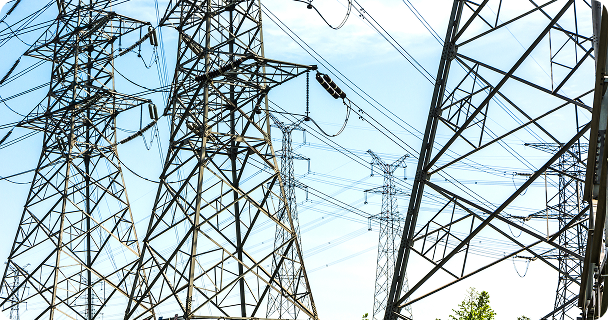
Electricity is electron movement. Lightning is an extreme example—to move the electric current in that bolt, it may require 5 billion joules, but harnessing that electric current for use is a complex process.
Every smartphone battery contains approximately 50,000 joules of energy, enabling us to stay connected in our daily lives through small amounts of electrical energy.
Thomas Edison built the first electrical power station in 1882, and thus began the development of the electrical grid, which today relies on a mix of fossil fuels, nuclear power, and renewables.

Sound travels as vibrations through air, water, or objects. The energy generated in daily conversation is quite small; the sound energy produced by one person talking is equivalent to about 0.000001 watts.
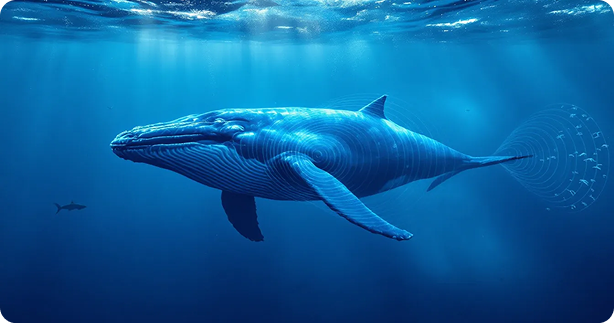
However, blue whales transmit sound energy from their voices, allowing them to listen in on each other hundreds of miles beneath the ocean.
NASA’s Saturn V rocket registered 220 decibels (roughly 100 million watts), and required special buildings to shield humans and equipment.
Sound can be for more than just communication it can serve as a diagnostic tool in ultrasound images, sonar, seismic data, and acoustic monitoring in preventive medicine and industries.

Radiant energy is all of the electromagnetic waves: visible light, X-rays, radio waves, and gamma rays. The special thing about radiant energy is that it transmits through empty space.
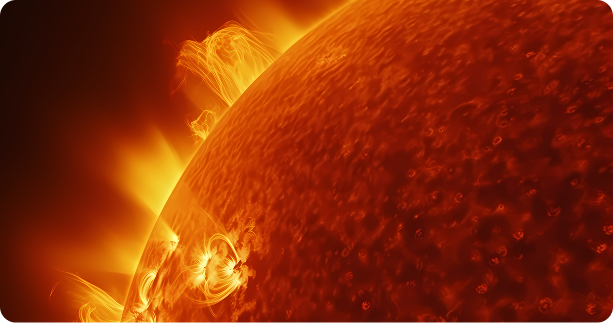
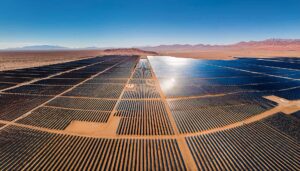
The Sun emits about 3.8 × 10^26 watts of radiant energy, which enables the existence of life on Earth and powers weather, solar panels, and other applications.
Solar panels typically convert only 15% to 22% of that energy into electricity. A device that uses this energy to heat food is a microwave, which utilises microwaves (specifically, 2.45 GHz microwaves).
Radio waves and X-ray have applications in communications and medicine.

Mechanical energy is the sum of an object's potential and kinetic energy.
For instance, with the historic time conservation device Big Ben, a pendulum used mechanical energy to measure time intervals precisely.
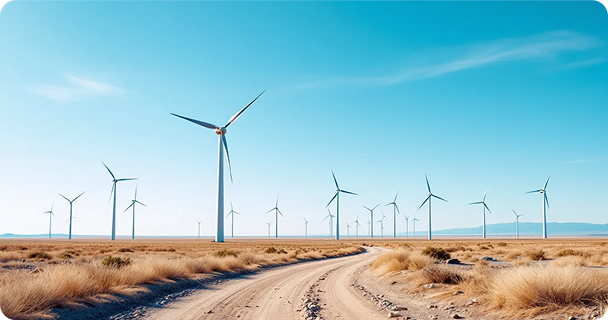
Wind turbines harness the kinetic energy from wind and produce enough electricity to potentially supply an entire neighbourhood, with some even capable of a 3 MW output.
Vehicle engines convert the chemical energy in fuel to mechanical energy to turn the wheels, but the vehicle only converts 25%-30% of that energy to useful motion, dissipating the remainder as heat.
Potential energy can be thought of as energy stored in a position before being expended.

This is the energy gained by an object as it rises to a height above the ground. An example of gravitational potential energy is a person on top of the Eiffel Tower has > 223,000 joules of (J) of gravitational potential energy.
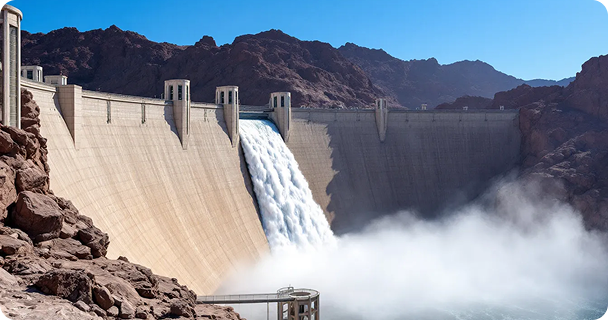
This powerful movement contributes to the production of electricity, highlighting the dam's role as a significant energy source.
Hydroelectric dams such as Hoover use this exact principle; as it has stored billions of gallons of water in the high reservoir, when the water level drops the gravitational potential energy is used to generate electricity; it is a renewable, carbon-free source of energy.
Also, roller coasters like Kingda Ka receive gravitational potential energy on the way down.

Chemical energy is caused by potential energy in the bond energy of atoms, and molecules. Gasoline stores a significant amount of energy--338,000 joules per liter--and allows for a small gas tank to run a car for hours.
AA batteries hold about 13,000 joules and allow for some of the most simple mechanisms to perform for days. Each person converts chemical energy from food into motion and thought.
A resting person uses about 80-100 watts, about the same as a working incandescent light-bulb. Engines transform the chemical energy of fuel into heat, and then motion.

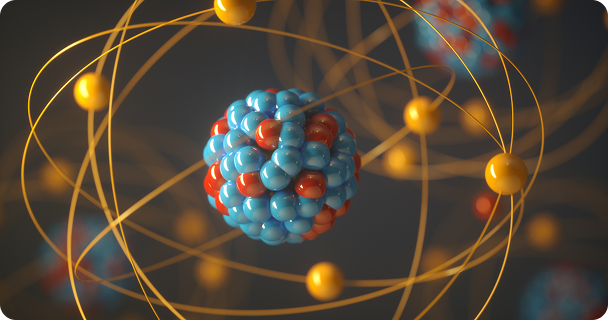
Nuclear energy is energy stored in the nuclei of atoms released through two processes, fission (splitting the atom) and fusion (combining atoms). The energy in a uranium pellet of the size of a nail contains the equivalent energy of 17,000 cubic feet of natural gas!
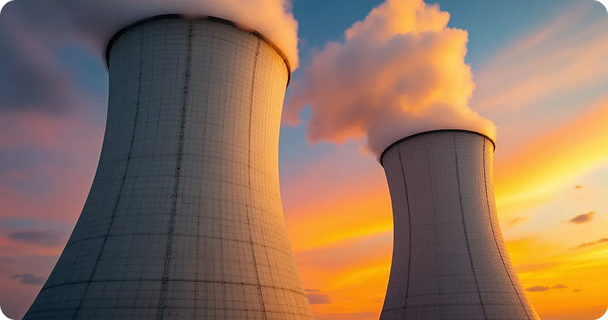
The atomic bomb dropped on Hiroshima released 63 trillion joules of energy, which demonstrates the power of Nuclear energy. The Palo Verde plant produces approximately 4,000 MW of low-carbon electricity through nuclear energy by controlled energy release.
The sun produces energy through nuclear fusion, a process that many scientists are pursuing to generate nearly limitless clean energy on Earth.

Elastic energy is energy stored in materials that bend, distort, or compress various forms of materials, such as rubber bands or springs. For example, the compression of a basketball is elastic potential energy, which was stored and released when the basketball hits the ground.
The springs in a car’s suspension use some elastic potential energy to absorb shock and provide a smooth ride.
Various weapons have also been used, such as bows and catapults, whose purpose was to initially use elastic energy to accelerate projectiles very quickly for propulsion.
The First Law of Thermodynamics states that energy cannot be created or destroyed; it can only be transformed or converted into other forms.
In nature, we are perpetually transforming energy (e.g. sunlight to chemical energy via plant growth, stored or potential energy from water behind a dam becoming kinetic energy as it flows downhill, then mechanical or electrical energy).
Some systems can be extremely effective; for example, hydroelectric plants can be 90 per cent effective, which is equivalent to claiming that only a tiny amount of energy is wasted.
Einstein’s equation E=mc2 highlights that matter and energy are interchangeable; for example, fusion reactions in stars convert minute amounts of matter into colossal amounts of energy.
In science, energy is measured using Joules. On a day-to-day basis, the metrics are:
Gasoline has 34 MJ/L, Lithium Ion Batteries have 0.5 to 1.5 MJ/L; conseq
Understanding energy forms and energy systems can create the impetus for innovation:
Electric vehicles like the Tesla Model S demonstrate different forms working in unison: batteries maintain chemical energy; motor(s) convert electrical energy to use; wheels convert to kinetic energy.
The regenerative brake returns energy, thus increasing efficiency.
The International Space Station employs solar panels (<120 kW) that produce electricity to support life in space. Steel mills require a high supply of thermal energy, a tremendous force of mechanical energy, and consistent access to electric energy to manufacture cars and the Eiffel Tower.
Biological systems are equally fascinating; in terms of energy, the human body uses energy from food to support movement, maintain an internal temperature, and communicate responses via nerve cells.
Green plants rely on the sun for energy and convert it into chemical energy, serving as the base for the food web.
The modern invention is based upon optimising efficiency; e.g. LED lights waste 80% less electricity compared to incandescent lights.
The new advancements in engines that convert larger percentages of fuel energy into mechanical energy, thus reducing wastage of the remaining energy from the first fuel conversion
In combination, understanding the relative forms of energy has allowed scientists and engineers to create more efficient, cleaner, and smarter energy solutions, including how we heat our homes and move ourselves into outer space (and all points in between).
Moving forward, we have to give consideration to how energy transformation and energy conservation will be critical in mitigating climate change while advocating for growth as well as new steps in to expand beyond what we know.
Lorem ipsum dolor sit amet, consectetur adipiscing elit. Suspendisse varius enim in eros elementum tristique.
Lorem ipsum dolor sit amet, consectetur adipiscing elit. Ut elit tellus, luctus nec ullamcorper mattis, pulvinar dapibus leo.
Subscribe to our Energy Job Search Blog newsletter and never miss out on the latest industry insights, expert tips, and exclusive updates. Whether you’re looking to stay ahead in your career or just want to stay informed, our newsletter delivers straight to your inbox.
By clicking Sign Up you’re confirming that you agree with our Terms and Conditions.